
No. Except in rare, life-threatening clinical emergencies, drug allergy testing and oral challenges are avoided during pregnancy to protect the fetus from any potential reaction.
Back to blog
Diagnostics
Drug Allergy Testing in Mumbai: Penicillin, Antibiotics, & Provocation Challenges
Reviewed by Dr. Sunita Chhapola Shukla
Published: 10 May 2026
Updated: 20 May 2026
6 min read
Clinical Summary
Suspected drug allergies often lead to patients being unnecessarily prescribed expensive alternative antibiotics. Discover how drug allergy testing safely confirms true drug hypersensitivity.
Many patients carry a lifetime label of being 'allergic to penicillin' or 'allergic to sulfa drugs' based on a childhood skin rash or minor side effect. However, clinical studies show that over 90% of patients labeled as penicillin-allergic do not actually have an IgE-mediated allergy when tested. Confirming a drug allergy through formal medical testing is critical, as avoiding first-line antibiotics forces doctors to use less effective, more expensive alternatives. To read more about other forms of diagnostic testing, view our guides on Food Oral Challenges and Patch Testing for delayed contact allergies.
The Clinical Impact of False Drug Allergy Labels
When a patient has a 'penicillin allergy' warning on their chart, hospital admission protocols require the use of broad-spectrum alternative antibiotics (such as vancomycin or clindamycin). These alternative medications carry a higher risk of adverse side effects, increase the length of hospital stays, lead to higher treatment costs, and drive the emergence of multi-drug resistant bacterial infections (superbugs). Evaluating and clearing a suspected drug allergy is a vital step in proactive healthcare.
“Drug allergy testing is a clinical safety shield. By proving you are not allergic to penicillin, we open up access to safer, first-line treatments for infections.”— Dr. Sunita Chhapola Shukla
How Drug Allergy Testing is Performed
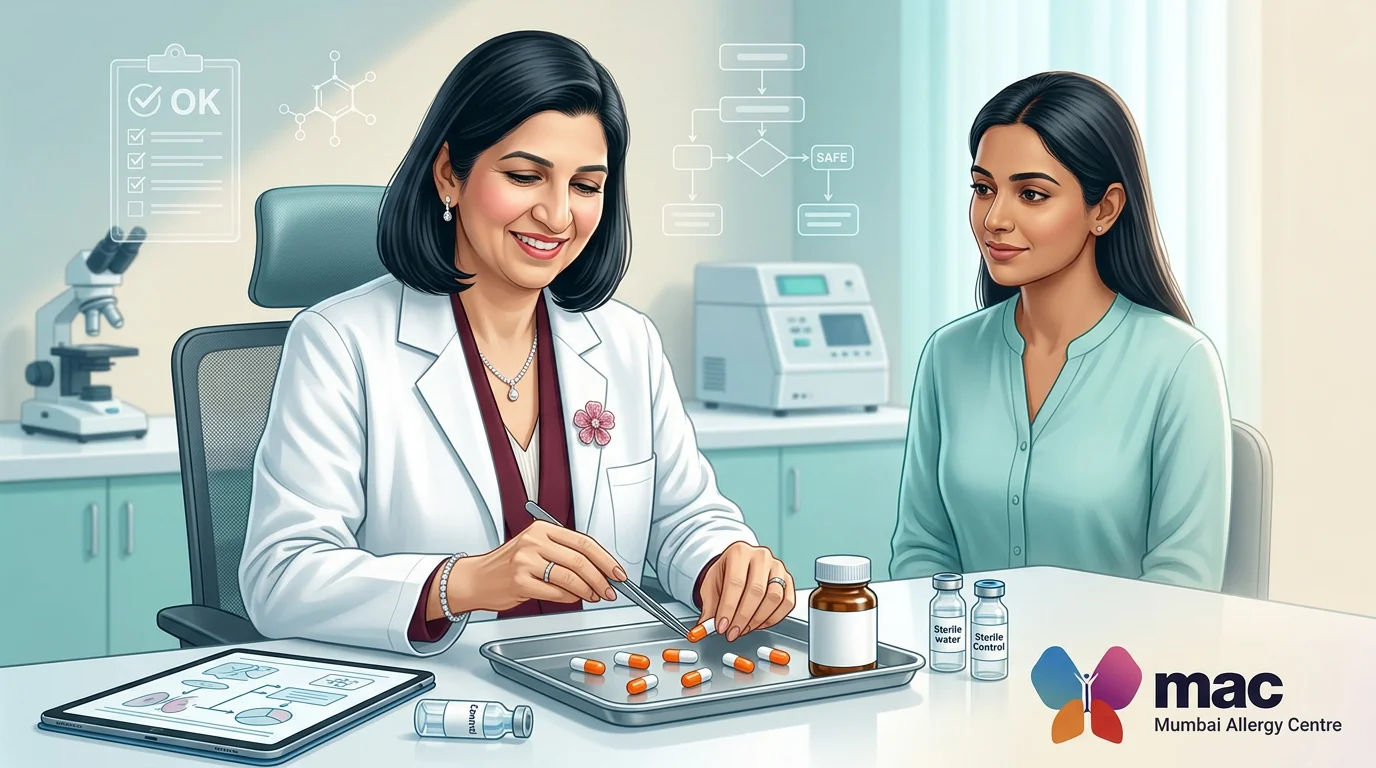
Drug allergy testing is a graded, highly controlled diagnostic protocol designed to evaluate hypersensitivity while minimizing patient risk. At Mumbai Allergy Centre, we follow the standard international guidelines:
- Detailed Clinical History: Documenting the exact drug, the type of reaction (rash, hives, difficulty breathing), when it occurred, and how long it lasted.
- Skin Prick Testing: A diluted droplet of the medication is placed on the forearm, and the skin is gently pricked. The area is observed for a wheel-and-flare reaction within 15 minutes. For details on how this is done, see our guide on Skin Prick Testing.
- Intradermal Testing: If the skin prick test is negative, a tiny volume of sterile, diluted medication is injected into the upper layer of the skin (dermis). This test is highly sensitive and essential for penicillin and local anesthetic evaluations. For details, see our guide on Intradermal Testing.
- Drug Provocation / Oral Challenge: If skin tests are negative, the patient consumes the medication in graded, increasing doses under close clinical supervision. This is the definitive test to confirm safe tolerance.
Common Medications Evaluated
At our Dadar clinic, we test for hypersensitivity to a wide variety of medications, including:
- Penicillin & Cephalosporin group of antibiotics.
- Local Anesthetics (e.g. Lignocaine, Bupivacaine) used in dental and minor surgical procedures.
- Non-Steroidal Anti-inflammatory Drugs (NSAIDs) such as Aspirin, Ibuprofen, and Diclofenac.
- Chemotherapy Agents (evaluated and managed via rapid desensitization protocols in hospital settings).
What is Drug Desensitization?
If testing confirms a true drug allergy, but the medication is absolutely essential (such as Aspirin for a cardiac patient with a recent coronary stent), we can perform rapid drug desensitization. This involves administering tiny, increasing doses of the drug over several hours in a hospital setting, temporarily resetting the immune response so the patient can tolerate the medication safely.

Author & Clinical Reviewer
Dr. Sunita Chhapola Shukla
Director of Mumbai Allergy Centre
MS (ENT), DNB, DAA (Gold, Harvard/Boston Food Allergy Centre)
Cited Sources & Medical References
- Demoly, P. et al. (2014). 'International Consensus on drug allergy.' Allergy, 69(4), 420-437.
- Solensky, R. et al. (2010). 'Drug allergy: An updated practice parameter.' Annals of Allergy, Asthma & Immunology, 105(4), 259-273.
- Joint Task Force on Practice Parameters. (2022). 'Penicillin allergy skin testing guidelines and challenges.'
Q&A
Frequently Asked Questions
Medical clarifications directly from Dr. Sunita Shukla
Frequently Asked Questions
A complete evaluation, including skin prick testing, intradermal testing, and a graded oral challenge, typically takes 3 to 4 hours of close clinical observation.
Take Control of Your Health
Don't let allergies hold you back. Consult Dr. Sunita Shukla.
Confirm your allergen triggers with standard in-clinic diagnostics and get a long-term desensitization plan.