
Yes. When conducted in a specialized clinic under direct monitoring and utilizing graded dosing protocols, food challenges are highly safe for infants and toddlers. It is often crucial to test them early so that unnecessary restrictions on developmental foods (like milk and wheat) can be removed.
Back to blog
Diagnostics
Food Challenge Test Mumbai: Graded Oral Challenges for Safe Food Allergy Diagnosis
Reviewed by Dr. Sunita Chhapola Shukla
Published: 20 April 2026
Updated: 20 May 2026
6 min read
Clinical Summary
For patients navigating the anxiety of suspected food allergies, a medically supervised Food Oral Challenge (OFC) remains the gold standard diagnostic test to confirm true tolerance or diagnose active allergies.
Suspecting a food allergy can introduce immense anxiety into a patient's or parent's life. Reading labels meticulously, avoiding dining out, and fearing accidental exposure are common struggles. However, many patients live with strict dietary restrictions based only on positive skin prick tests or IgE blood tests, which frequently yield false positives. To establish the absolute truth, modern clinical immunology relies on a single gold-standard diagnostic procedure: the medically supervised Oral Food Challenge (OFC). For persistent food allergies, some patients can undergo Food Oral Immunotherapy (OIT) to build active tolerance.
Why Traditional Allergy Tests Aren't Enough
Traditional diagnostics like skin prick testing (SPT) and whole-allergen allergy blood tests (ImmunoCAP) are highly sensitive, meaning they are excellent at identifying if your body has created IgE antibodies to a specific food. However, they lack clinical specificity. A positive skin or blood test only indicates 'sensitization', that your immune system has recognized the allergen, not necessarily that you will react to it when eaten. In fact, up to 50% to 60% of positive food allergy skin tests do not translate to a real-world reaction.
“Sensitization does not equal clinical allergy. Restricting vital foods from a child's diet based solely on a skin prick test can lead to nutritional deficiencies and actually prevent natural tolerance development.”— Dr. Sunita Chhapola Shukla
What is a Graded Oral Food Challenge?
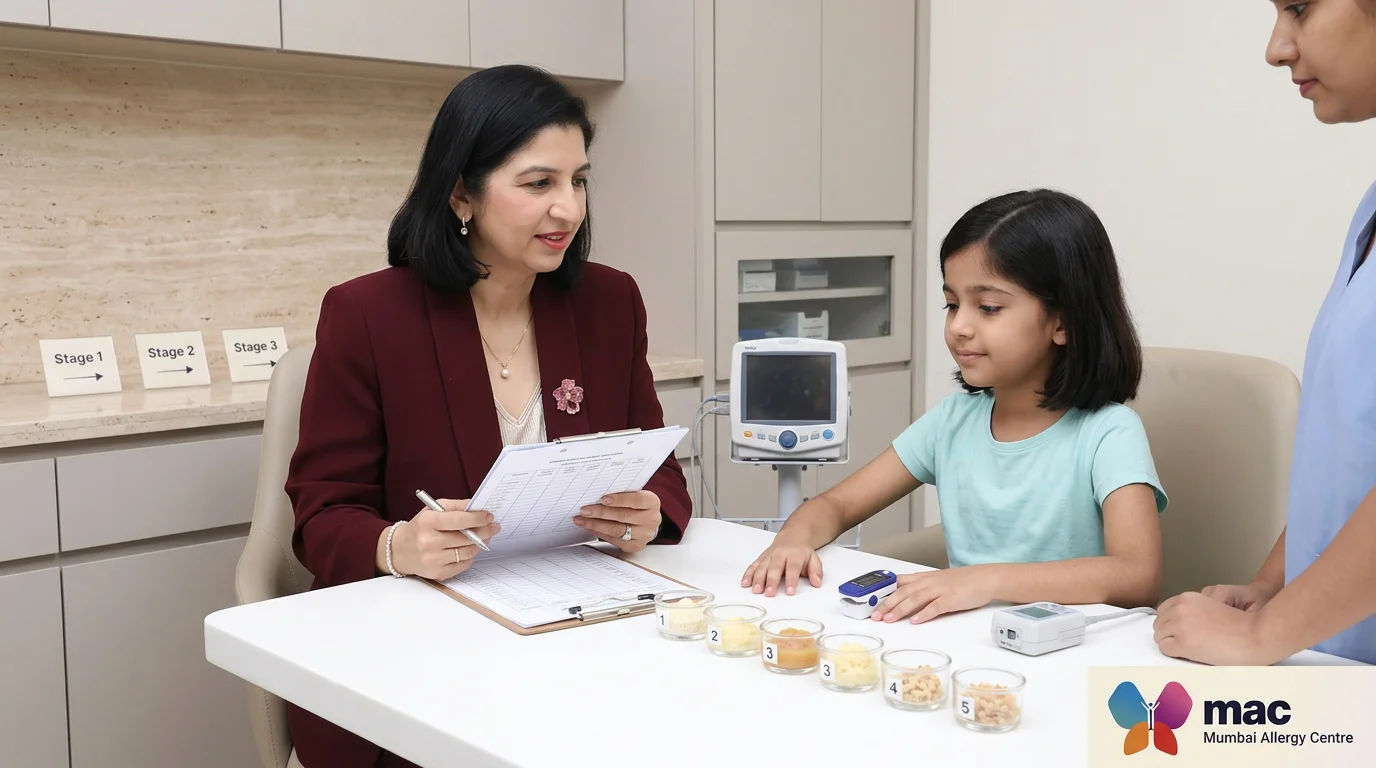
An Oral Food Challenge is a controlled clinical procedure where a patient consumes a suspected allergen in gradually increasing amounts under direct medical supervision. The doses start at an microscopic level (far below the threshold of triggering a reaction) and escalate incrementally. If the patient tolerates the final, standard-sized dose without any symptoms, a true food allergy is ruled out, and the food can be safely reintroduced into their daily diet.
The Step-by-Step Procedure at Mumbai Allergy Centre
At our Dadar clinic, safety is the overriding priority. Every Oral Food Challenge follows a strict, standardized clinical protocol:
- Pre-Test Screening: The patient is thoroughly evaluated. They must be in good health (no active asthma symptoms or colds) and must have stopped all antihistamine medications for at least 7 days before the test.
- Graded Dosing: The food is administered in 5 to 6 incremental doses, typically starting with 1/100th or 1/10th of a normal portion. Doses are spaced 15 to 20 minutes apart.
- Vigilant Clinical Monitoring: Before each escalation, a specialist checks the patient's vital signs (pulse, blood pressure, oxygen saturation) and conducts a skin, oral, and lung examination.
- Post-Challenge Observation: If the patient successfully completes all doses without symptoms, they are kept under observation for an additional 2 hours. This ensures that delayed-onset reactions are fully ruled out.
Safety Protocols and Emergency Preparedness
Because food challenges carry an inherent risk of triggering an allergic reaction, they should never be performed at home or in an unequipped medical office. Under the supervision of Dr. Sunita Chhapola Shukla, MAC is fully prepared for any emergency. We maintain immediate access to intravenous fluids, oxygen support, bronchodilators, antihistamines, steroids, and intramuscular epinephrine (adrenaline), the primary rescue drug for anaphylaxis. Because we start with minute doses, any reaction that does occur is usually caught early and resolved quickly with minor intervention.

Author & Clinical Reviewer
Dr. Sunita Chhapola Shukla
Director of Mumbai Allergy Centre
MS (ENT), DNB, DAA (Gold, Harvard/Boston Food Allergy Centre)
Cited Sources & Medical References
- Bindslev-Jensen, C. et al. (2004). 'Standardization of double-blind, placebo-controlled food challenges in patients with immediate allergic reactions to food.' Allergy, 59(7), 690-697.
- Sampson, H. A. et al. (2014). 'Standardizing double-blind, placebo-controlled oral food challenges: consensus report.' Journal of Allergy and Clinical Immunology, 134(6), 1370-1378.
- European Academy of Allergy and Clinical Immunology. (2021). 'OFC safety guidelines and dose protocols in pediatric allergy.'
Q&A
Frequently Asked Questions
Medical clarifications directly from Dr. Sunita Shukla
Frequently Asked Questions
The challenge is stopped immediately at the first objective sign of a reaction (e.g. hives, coughing, or lip swelling). Rescue medications are given right away. Once the symptoms resolve, the test is marked positive, confirming the food allergy.
Take Control of Your Health
Don't let allergies hold you back. Consult Dr. Sunita Shukla.
Confirm your allergen triggers with standard in-clinic diagnostics and get a long-term desensitization plan.