
No. The test uses a tiny lancet that lightly pricks the surface of the skin, most patients describe it as a small scratch rather than a needle injection. There is no bleeding, and any itching at positive sites is temporary and settles quickly.
Back to blog
Diagnostics
Skin Prick Test in Mumbai: Cost, What to Expect, and How Accurate It Is
Reviewed by Dr. Sunita Chhapola Shukla
Published: 8 June 2026
Updated: 15 June 2026
6 min read
Clinical Summary
The skin prick test is the fastest, most reliable way to identify your allergy triggers, delivering results in just 20 minutes. Here is exactly how it works, how to prepare, what affects the cost, and how to interpret your results.
If you suffer from recurring sneezing, itchy eyes, rashes, or unexplained reactions, the most important first step is to identify exactly what you are allergic to. Guesswork and elimination diets waste months and rarely give clear answers. The Skin Prick Test (SPT) is the international gold standard for diagnosing IgE-mediated allergies, it is quick, minimally invasive, and delivers precise results within 20 minutes. Here is everything you need to know before booking one in Mumbai.
What Is a Skin Prick Test?
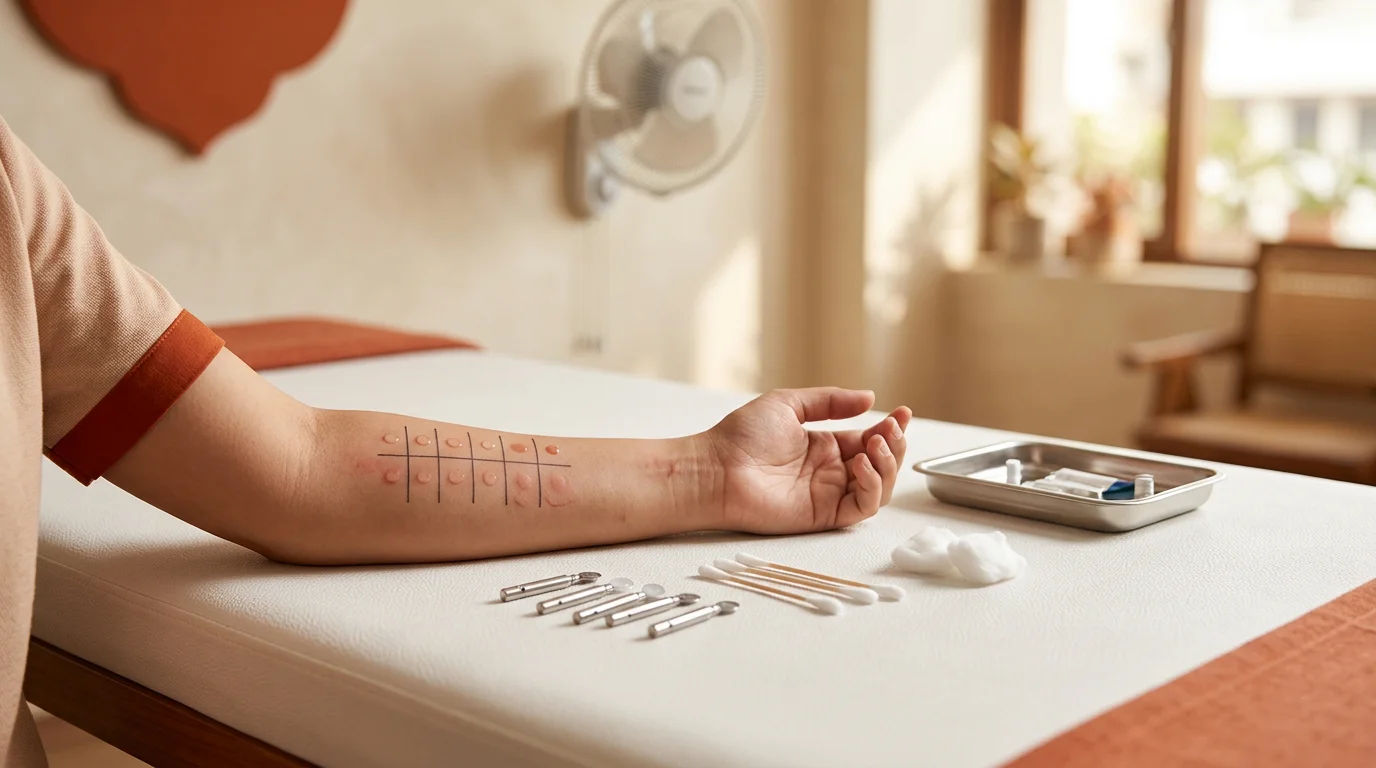
A skin prick test exposes your skin to tiny amounts of purified allergen extracts to see whether your immune system reacts. Drops of different allergens, such as dust mites, pollen, mould, pet dander, and foods, are placed on your forearm or back. The skin beneath each drop is then gently pricked with a sterile lancet, allowing a microscopic amount of allergen to enter the outermost skin layer. If you are allergic to a substance, a small raised, itchy bump (a wheal) surrounded by redness appears at that spot within 15 to 20 minutes.
“In a single 20-minute sitting, a skin prick test can screen for dozens of allergens at once. There is no faster or more cost-effective way to convert months of guesswork into a clear, actionable diagnosis.”— Dr. Sunita Chhapola Shukla
What to Expect During the Test
The procedure is simple, safe, and suitable for both adults and children. Here is the typical sequence at our clinic:
- Mapping: The skin on your forearm or back is cleaned and marked into a grid so each allergen can be tracked.
- Application & Pricking: Allergen drops are applied and the skin is lightly pricked, most patients describe it as a tiny scratch, not a needle injection. It is virtually painless.
- The 20-Minute Wait: You wait while the skin reacts. Positive spots become itchy, raised bumps; this itching is temporary.
- Reading & Interpretation: The specialist measures each wheal against positive and negative control drops to determine which allergens you are genuinely sensitised to.
How to Prepare: The Antihistamine Rule
The single most important preparation step is stopping antihistamines before the test. Antihistamines suppress the skin's ability to react and will produce false-negative results. You should stop most oral antihistamines for 5 to 7 days before testing (your doctor will advise on the exact medication). Asthma inhalers, nasal sprays, and most other regular medicines can usually be continued. Always share your full medication list when booking so we can guide your preparation.
How Accurate Is the Skin Prick Test?
For inhaled (environmental) allergens like dust mites, pollen, mould, and pet dander, the skin prick test is highly sensitive and reliable, making it the diagnostic test of choice. For foods, a positive result indicates sensitisation but does not always confirm a clinical allergy, up to half of positive food results may not cause real-world reactions. This is why food results are always interpreted alongside your history and, when needed, confirmed with an Oral Food Challenge. When skin testing is not possible (for example, severe eczema or unavoidable antihistamine use), an allergy blood test is an effective alternative.
What Determines the Cost?
The cost of a skin prick test depends primarily on the number and type of allergens tested, a focused panel for suspected dust mite allergy costs less than a comprehensive panel covering inhalants and multiple foods. Specialised extracts and component testing add to the cost. Rather than choosing the largest panel by default, our specialists tailor the panel to your symptoms and history, which keeps testing both clinically meaningful and cost-effective. For exact, current pricing and to plan the right panel for your symptoms, contact our Dadar clinic directly.

Author & Clinical Reviewer
Dr. Sunita Chhapola Shukla
Director of Mumbai Allergy Centre
MS (ENT), DNB, DAA (Gold, Harvard/Boston Food Allergy Centre)
Cited Sources & Medical References
- Heinzerling, L. et al. (2013). 'The skin prick test – European standards.' Clinical and Translational Allergy, 3, 3.
- Bernstein, I. L. et al. (2008). 'Allergy diagnostic testing: an updated practice parameter.' Annals of Allergy, Asthma & Immunology, 100(3 Suppl 3), S1-S148.
- Frati, F. et al. (2018). 'The skin prick test.' Journal of Biological Regulators and Homeostatic Agents, 32(1 Suppl. 1), 19-24.
Q&A
Frequently Asked Questions
Medical clarifications directly from Dr. Sunita Shukla
Frequently Asked Questions
Yes. Skin prick testing is safe and commonly performed in children, including young ones. Because it is quick and nearly painless, most children tolerate it well, and it is often the preferred first-line test for diagnosing allergies in kids.
Take Control of Your Health
Don't let allergies hold you back. Consult Dr. Sunita Shukla.
Confirm your allergen triggers with standard in-clinic diagnostics and get a long-term desensitization plan.