
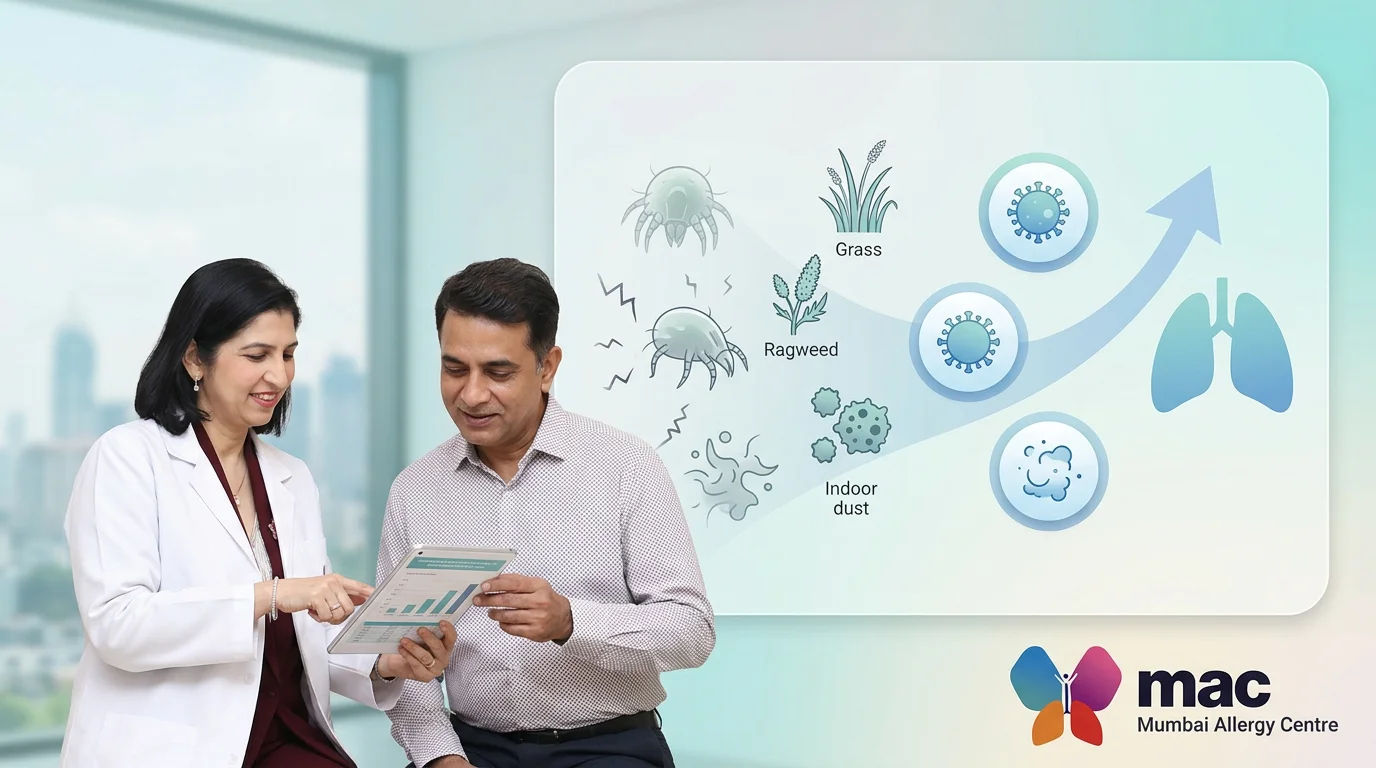
Yes. SLIT (sublingual drops) is highly recommended for children aged 5 and older who suffer from moderate-to-severe allergic rhinitis or asthma. It has been shown to prevent the 'allergic march', the progression of nasal allergies into chronic asthma.
Back to blog
Treatments
Immunotherapy Mumbai: The Definitive Guide to Dust Mite & Inhalant Desensitization
Reviewed by Dr. Sunita Chhapola Shukla
Published: 2 May 2026
Updated: 20 May 2026
6 min read
Clinical Summary
Allergy immunotherapy is the only disease-modifying treatment that can cure dust mite and environmental allergies. Learn how desensitization works and what options are available in Mumbai.
For patients suffering from chronic sneezing, nasal congestion, and asthma, standard medical treatment has long relied on symptom suppression: antihistamines, eye drops, and steroid inhalers. While these provide relief, they do not cure the underlying condition. Allergen Immunotherapy, however, stands as the only disease-modifying treatment in modern medicine that can train your body to tolerate allergens, addressing the root cause of the allergic response.
The Challenge of Dust Mites in Mumbai's Climate
Mumbai's tropical, coastal climate is uniquely challenging for allergy patients. The high relative humidity (rarely dropping below 70%) combined with warm temperatures creates a perfect breeding ground for Dermatophagoides species (house dust mites). These microscopic organisms thrive in mattress fibers, upholstery, and carpets. Unlike seasonal pollen allergies in Western countries, dust mite allergy in Mumbai is perennial, exposing patients to a constant inflammatory stimulus every day of the year.
“Traditional allergen avoidance, such as washing sheets and running air purifiers, is helpful but rarely sufficient in Mumbai. The ambient humidity is simply too high, making immunotherapy the primary route to lasting clinical remission.”— Dr. Sunita Chhapola Shukla
How Allergy Immunotherapy Works
Allergy immunotherapy works on the principle of progressive desensitization. We introduce extremely small, purified concentrations of your specific allergen into your body, gradually increasing the dose over time. This controlled exposure alters how your immune system responds to the allergen:
- Suppression of IgE Antibodies: The immunoglobulins responsible for initiating the allergic reaction are gradually downregulated.
- Induction of IgG4 Blocking Antibodies: The body produces 'protective' antibodies that bind to allergens before they can reach IgE receptors.
- T-Regulatory Cell Activation: Immune system coordinator cells (Tregs) are activated, promoting long-term mucosal tolerance and suppressing allergic inflammation.
Comparing SLIT (Drops) and SCIT (Shots)
At Mumbai Allergy Centre, we offer both major forms of allergen immunotherapy, customizing the delivery route to the patient's lifestyle and age:
- Sublingual Immunotherapy (SLIT): Formulated as customized liquid drops placed under the tongue daily. It is needle-free, highly safe, and self-administered at home. For details, read our guide on Sublingual Immunotherapy (SLIT) Solution.
- Subcutaneous Immunotherapy (SCIT): Traditional allergy shots administered in a clinical setting. Shots are given weekly during the initial 'build-up' phase and monthly during the 'maintenance' phase. For details, read our guide on Subcutaneous Immunotherapy (SCIT) Treatment.
What to Expect: Timeline and Long-term Efficacy
Immunotherapy is a gradual process. The standard course takes 3 to 5 years. While some reduction in symptom severity is typically noticed within the first 3 to 6 months, completing the full course is essential to modify the immune system permanently. For detailed breakdown of pricing, see our Cost-Benefit Analysis of Immunotherapy.

Author & Clinical Reviewer
Dr. Sunita Chhapola Shukla
Director of Mumbai Allergy Centre
MS (ENT), DNB, DAA (Gold, Harvard/Boston Food Allergy Centre)
Cited Sources & Medical References
- Calderon, M. A. et al. (2012). 'Allergen immunotherapy for allergic rhinitis.' Cochrane Database of Systematic Reviews, (7), CD001950.
- Durham, S. R. et al. (2018). 'Long-term clinical efficacy of grass pollen sublingual immunotherapy.' Journal of Allergy and Clinical Immunology, 141(1), 220-229.
- World Allergy Organisation. (2020). 'Immunotherapy guidelines for perennial respiratory allergies in high-humidity zones.'
Q&A
Frequently Asked Questions
Medical clarifications directly from Dr. Sunita Shukla
Frequently Asked Questions
Clinical trials indicate that both methods are highly effective, showing over an 80% success rate in properly diagnosed patients. The choice between them usually depends on patient preference regarding needles, clinic proximity, and daily compliance.
Take Control of Your Health
Don't let allergies hold you back. Consult Dr. Sunita Shukla.
Confirm your allergen triggers with standard in-clinic diagnostics and get a long-term desensitization plan.